
System Health Record “SHR©”
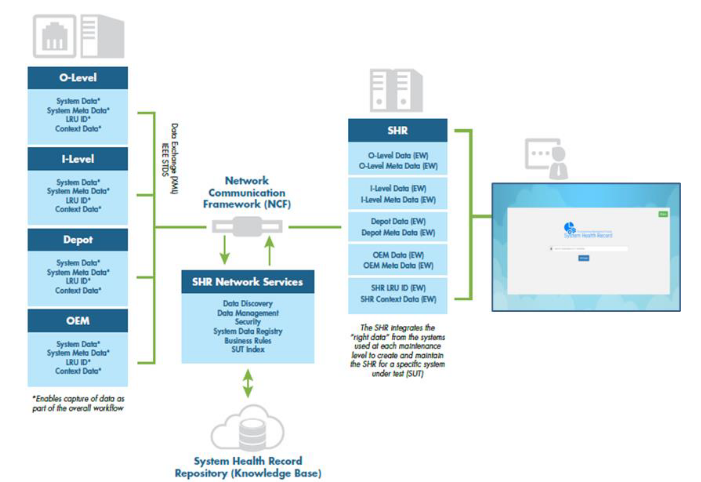
- The System Health Record (SHR©) is an electronic record of a system’s state of health (SOH), diagnostic activity, and maintenance history. The record develops from information generated during diagnostic sessions, testing, and maintenance events.
- For each uniquely identified Unit Under Test (UUT), the SHR© brings together general system information, technician notes, reported problems, Built-In-Test indications, health parameters, troubleshooting actions, repairs, maintenance history, test data, and test results.
- The SHR© is a single, unique system health record that may be created, maintained, and stored across one or more physical systems within a maintenance organization.
- Each maintenance event adds to the UUT’s history by recording what was observed, tested, repaired, and returned to service. Over time, these events create a traceable account of the maintenance and testing performed throughout the unit’s lifecycle.
- By supporting the collection, transformation, mapping, management, and exchange of health-state data, the SHR© connects information across levels of maintenance and makes the unit’s history available when future decisions must be made.
System Health Record and Healthcare's Electronic Health Record
Why Implement The System Health Record?
Electronic Health Records transformed healthcare by giving providers access to a patient’s connected history instead of requiring each encounter to be considered in isolation. GSS applies that same principle to complex maintained systems: decisions are better informed when current conditions can be evaluated alongside previous problems, tests, repairs, and outcomes.
What GSS Created
The System Health Record (SHR) provides a data integration solution for acquiring, connecting, processing, distributing and managing health state data across all levels of maintenance. The SHR stores, maps, and displays aircraft Built-In-Test (BIT) data, Automatic Test Equipment (ATE) results, and maintenance action data together for each Unit Under Test (UUT) within one repository. The critical connections and trends established by the SHR enables users to make informed and efficient decisions using the UUT’s entire health history across all levels of maintenance.
Benefits
- Enables significant operational benefits by reducing or eliminating time and costs associated with the “hit or miss” trial and error testing and repair methods and the No-Fault-Found (NFF) incidents.
- Delivers higher rates of operational system availability and significant reductions in aircraft operating and support costs by replacing parts accurately and before they fail.
- Integrates with existing automated logistics and maintenance environments by using information those systems already generate.
- Each maintenance event results in the capture of data to provide a record of the maintenance and testing that has been performed.
- The SHR© enables the efficient collection, transformation and exchange of health state data across levels of maintenance.
What Healthcare Created
The healthcare industry created the Electronic Health Record (EHR) to organize a patient’s medical information into an accessible, longitudinal record. With appropriate authorization and security controls, EHR systems allow information to be shared among patients, providers, and healthcare organizations.
This connected record helps healthcare professionals understand the patient’s history, coordinate care, reduce documentation burdens, prevent avoidable errors, and make better-informed decisions.
Benefits
- Improved financial and administrative outcomes
- Improved quality and coordination of care
- Better-informed clinical decisions and fewer avoidable errors
- Reduced documentation time and paperwork
The strength of an EHR is not limited to storing information. Its value comes from preserving context across encounters and making that context available when care decisions are made. As a healthcare organization grows, the record can incorporate additional patients, providers, data sources, and technologies.
The SHR© brings the same connected-record concept to system maintenance. As a unit progresses through its operational life, the SHR© grows with it—preserving maintenance and diagnostic evidence, incorporating new events and data sources, and providing a more complete foundation for future maintenance decisions.